Restoring relations for collective liberation
Rites & Responsibilities is dedicated to restoring cultural conditions conducive to ecological integrity through community-based ritual practices for individuals, families, and communities.
Within all of our work, we illuminate and address the critical role of community-based ritual practices in self-determined communities; the impacts when such practices are lost, stolen, and sacrificed; and how such practices can be reclaimed and regenerated in responsible, relevant, and life-affirming ways.
We offer an assortment of community, land-based, and online experiences and trainings; a guidebook for navigating life’s transitions; and healing-centered tools designed to support people in bringing rites of passage and other community-based ritual practices into their lives, families, and communities.

At the heart of Rites & Responsibilities is a system of Cultural Habitat Restoration, an emerging system of cultural change rooted in ritual-based practice designed to facilitate healing for individuals, families, communities, and the broader cultural habitat, and restore conditions conducive to ecological integrity.
Our Organizing Philosophy
-
Cultural Habitat Restoration (CHR) draws its foundational metaphor from the work of conservation biologists, ecologists, and systems designers—especially those grounded in Indigenous Ways of Knowing—as they work to mitigate and repair harms to rivers, streams, wetlands, and other earthly ecosystems. These efforts show that even in deeply damaged places, it is possible to restore the conditions necessary for life to thrive once again.
CHR applies this lens to our cultural world. Biology teaches us that a habitat is “a place where an organism makes its home,” meeting all of the necessary conditions for survival. Cultural habitat, then, is the social and cultural environment in which a group of people make their home, containing all of the conditions necessary for individual and collective survival and flourishing.
When we say “restoring,” we’re not trying to imply there is some perfect, ideal state and if only we could get back to it, everything would be OK. What we are saying is that we’re clear that the dominant policies, structures, and systems driving us as a global human community today continue to degrade our cultural and ecological well-being, not to mention their profound effects on individual health and safety in ways that are deeply unequal depending on things like where you live, what your skin color or gender is, and how much money you have.
In this age of climate devastation, global war and famine, large-scale industrial extraction, rapid technological change, and the lasting legacies of past and present colonial violence, those of us alive today find ourselves in a time of great precarity and tumult—which is also a time of great possibility. Change only comes when the discomfort of the status quo becomes more intense than the fear of the unknown. Here are some of the changes we’re working toward as guiding principles for restoring cultural habitat:
Repairing the false split between between the human and the non-human worlds, responsibly reclaiming and regenerating practices to connect people with land, water, cosmos, their ancestors, future generations, and each other;
Attuning individuals and communities to the wisdom in their bodies and hearts, and their capacities for honoring and nurturing their sensual, creative, and generative potential as well as their limits and boundaries;
Situating ourselves within a long arc of time, connecting our efforts in the present moment to the efforts of our ancestors all the way back to the beginning of time, as well as to future generations who will inherit the legacies we leave behind;
Reorienting the way we relate to money and resources by moving away from hoarding and exploiting, and toward free flow of exchange and sacred reciprocity;
Addressing unequal structures of power, both explicit and implicit, to ensure risk is more equally distributed and all members of our communities feel safe, secure, and able to live free lives and contribute to the broader good.
-
Rites of passage are a set of diverse cultural practices designed to intentionally honor life transitions. Many of the social issues we face today, from individual isolation to the rise of white nationalist hate groups and other forms of extremism, have their roots in, or are amplified by, the loss and contortion of these practices. When such practices are lost or destroyed, everyone suffers. When they are restored, the whole community can flourish. Through processes of initiation, individuals shed what has become too small for them, and are challenged and supported in developing the inner resources and understandings to bring their unique gifts forward—into a world that urgently needs what they have to offer.
In an age of climate devastation, global war and famine, large-scale industrial extraction, rapid technological change, and the lasting legacies of past and present colonial violence, we are alive in a time of great precarity and tumult—which means we are also in a time of great possibility. If change is inevitable, we might as well do change well: letting ourselves be transformed in the process, rather than fighting it every step of the way.
Within these initiatory times, rites of passage instill a sense of belonging, teach transition literacy (the ability to read, understand, and navigate change), and call forth the unique gifts of each of us, in service to our wider communities. Everyone has a right to a vibrant, life-affirming culture imbued with meaning, a culture that views each person as an essential piece of the greater whole. And everyone has a responsibility to make their life as full, rich, and meaningful as they possibly can. Grounded in human developmental theory and the practicality of developing meaningful rites of passage for a variety of life transitions, Rites & Responsibilities offers a compass—and trustworthy guides—for that life-long journey.
Rites & Responsibilities works within seven different realms: rites of passage, rites of grief & loss, rites of time-keeping, rites of agency & choice, rites of conflict repair & transformation, rites of sharing, and rites of belonging. Learn more about these on Our Offerings page.
-
A core part of how we practice CHR at Rites & Responsibilities is through ritual. Despite decades of development as a research field, there remains no singular definition of ritual, and indeed, words like ritual, ceremony, and rites are often used in contradictory ways.
For us at Rites & Responsibilities, when we talk about ritual, we mean sequences of bodily acts or behaviors imbued with symbolic meaning, engaged in ways that affirm life, respect sovereignty and interdependence among all beings, and help people navigate (rather than suppress) change. We appreciate the work of scholars like Molly Farneth who, in The Politics of Ritual, details how traditional religious ritual practices have been enacted publicly in protest of injustice. She writes that “rituals can hold together continuity and change,” and can “play a role in both protest and mourning, as well as in imagining a world that is better: more just, more democratic. Rituals can conjure not only the past but also a future.” Our work orients toward this future-conjuring power of ritual.
Ritual includes a range of forms, including altarwork, engagement of the senses, repetition, physical movement, artistic expression, engagement with the elements, meditation/contemplation, prayer/invocation, making libations/offerings/gifts, and sharing sacred stories, to name a few. These forms, enacted consciously, create fertile ground to ripen, navigate, and integrate transformation. More and more researchers are studying the impacts of ritual, with meaningful results on individual and community health and well-being. Unfortunately, it’s also an area that sees little funding support for both practitioners and researchers, something that we at Rites & Responsibilities (along with colleagues, collaborators, and conspirators from around the world) are working to change.
Rites & Responsibilities engages community-based ritual practice to enact life-affirming change in our human ecologies, moving within seven pathways of Cultural Habitat Restoration. You can read more about these seven pathways and how we engage them on Our Offerings page.
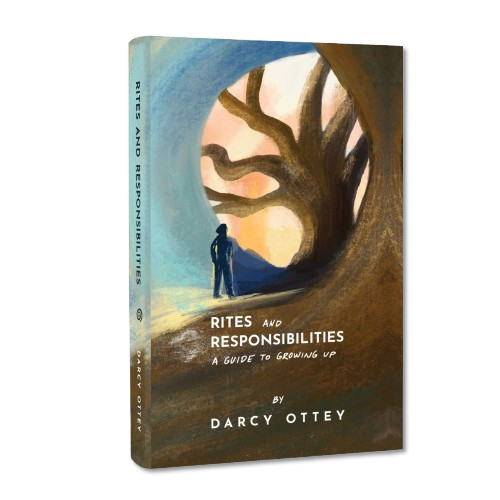
The Book
More than ten years in the making, this book gathers what we’ve learned about the process of transitioning into meaningful belonging in one place. Rites and Responsibilities: A Guide to Growing Up introduces young people to rites of passage into adulthood: what they are; what they offer; how they came to be stolen, destroyed, or co-opted in most cultural traditions; and how young people can take responsibility for their own rites of passage into adulthood today.
“History has shown that a surefire way to devastate a culture is to destroy its process of youth initiation, and to take over the education of young people. Regenerating cultural practices like rites of passage helps to restore community well-being and re-build resilient cultural landscapes.”
— from Rites and Responsibilities: A Guide to Growing Up
Who We Are
-
![]()
Darcy Ottey
-
![]()
Anaka Mines
-
![]()
Lucy Ní hAodhagáin
-
![]()
Marisa Withey Byrne
-
![]()
Melissa Goodblanket
-
![]()
Ramon Gabrieloff Parish
-
![]()
Scott Davidson
-
![]()
Shay Sloan Clarke
-
![]()
Sobey Wing